For Ordering Online click here
Email the Gallery at
wmg@jamescgroves.com
Historical Oil Painting Varnishes and Mediums
Oil-resin varnish has always been created by combining a resin with an oil, often through high temperature heats. Most common varnishes utilized down through the ages were intended to coat and protect furniture, architecture, boat-hulls and implements. Such common varnishes were composed of mostly oil -generally three parts oil to one of resin. As there is already ample oil within oil paints, special varnishes that were high in resin-content while low in oil were preferred and sought after by painters. Western Maryland Gallery offers unique historically-accurate painting varnishes and mediums primarily intended for use with both handground oil paint and today's commercial 'tube' colors. Some of these varnishes have been used as far back as the 1400's. All of these varnishes/mediums allow certain desirable effects not attainable through the use of commonly-available varnishes or by straight oil-and-pigment paint, alone. These special varnishes produce proper effects when used within either an "all-oil" (no solvents) painting technique or within those methods involving turpentine, or other solvent-use. Oil paintings made with these same historical additives have shown excellence in craftsmanship and durability down through the ages. A properly-made oil varnish will not yellow to any noticeable degree, excepting with great age. These particular varnishes and mediums appear to have truly stood the test of time.
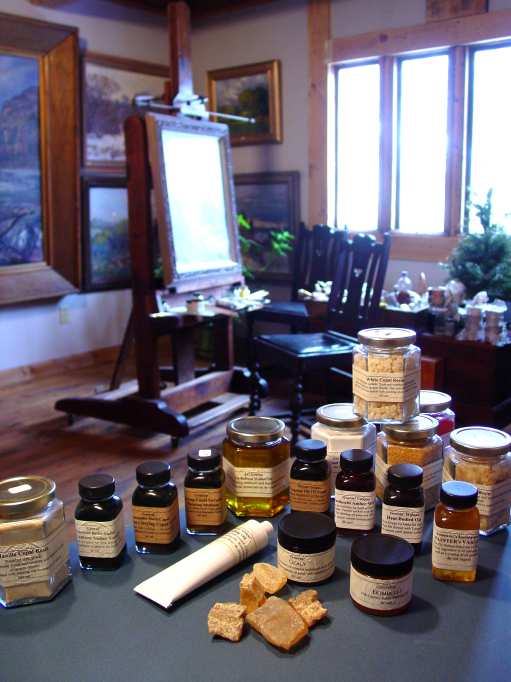
These historical painting varnishes /mediums are made in small batches. As aging is often important to strength and painting performance, the copal and amber varnishes are allowed to 'sleep' several months before sale. These varnishes/mediums are very strong in effects and, when utilized as additions to oil-colors, a bottle of any will last through approximately 20 or more 24"x30" paintings. Our painting varnishes and mediums are contained in either 90 mil. tube-form, or attractive 60 mil. glass bottles that fit perfectly into artist's sketch boxes.
Note: true hard copal and amber varnishes are rare in the world today. The ratio of resin-to-oil quantities (and the type of oil) as well as the length and degree of actual cooking of the varnishes, allow for noticeable differences in their ultimate characteristics when used with oil paint. Our varnishes are unique to our manufacture and perform like none other. Many recipes for amber and copal varnishes found in manuscripts and other textual sources are actually unfit for applications to oil painting. Varnishes that are too dark, too high in oil-content, or varnishes that dry too quickly are rather best suited for wood applications instead. With these considerations in mind I have, through much trial-and-error, selected only those varnishes that are suitable to oil painting. [Notice: Some of the following varnishes contain slight amounts of turpentine spirit. Be aware that though considered harmless to health in actual painting practices, care should be taken that none of the painting varnishes and mediums become ingested.]
James C. Groves
Click on each item's name for the complete historical and supporting research--includes method of use.
Historical Oil Painting Varnishes
16th Century Amber Varnish Venetian Amber Varnish Amber Oil of Venice 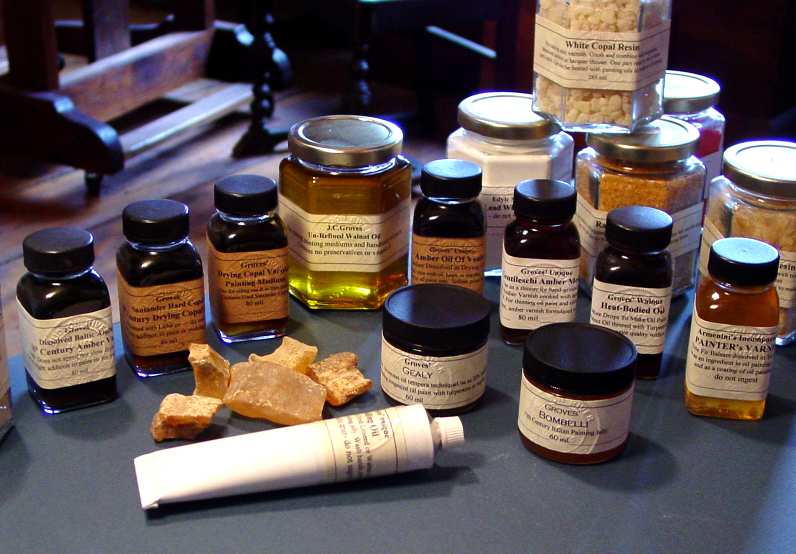
Gentileschi Amber Medium
$24.50 per 80 mil. glass bottle. Historically used in an all-oil-and-no-solvent manner, though it can also be used with a solvent, if desired. Created using our Venetian Amber Varnish combined with aged unrefined walnut oil-- nothing could be finer for an all-oil technique in the very same manner as Orazio Gentileschi .[Click on the product name for more info.] Ordering Online19th Century Copal Varnish
-- $24.50 per 80mil.bottle. Our most popular copal varnish. Very light in color. This is a classic "oil copal" formulation utilizing the lightest, clearest, hardest copal available. No driers added. Does not affect the normal drying of the paint. Very high in copal resin-content: 50% copal to 50% heat-polymerized linseed oil. A small addition causes oil paint to become crisp in consistency, allowing effects not otherwise possible. Use to make mediums allowing the same luscious painting effects as seen in many 19th C. works. Adding 1-part of this varnish together with 1-part of gum spirits of turpentine produces John F. Carlson's favorite painting medium. Click on the blue heading for more info concerning this product as well as the following quicker-drying version of this copal varnish. Caution: Never attempt to dilute this true copal varnish with mineral spirits (MS). Instead, use only turpentine spirits, spike oil, or d-limonene. If you wish to use MS as your painting-diluent, add the pure copal varnish to the paint first; then dilute the treated paint with MS. Also, do not add a drying oil (linseed, nut, poppy, etc.) to this copal varnish before first adding-in turpentine. [For more info, click on the product name.] Ordering Online19th Century Drying Copal Varnish
$25.50 per 80 mil. bottle. The fast-drying version of our 19th C. Copal Varnish. Darker than our regular version (above) due to being cooked with litharge/manganese, DCV was favored by many greats of the 19th Century, including the Pre-Raphaelites. This type of copal varnish all but disappeared from artistic use by the early 20th Century. DCV increases the drying ability of oil paint, either commercial tube paint or studio-made and provides excellent working qualities, clever brushwork, easy painting whether alla prima or layered. A small tempering (addition) to oil paint causes all colors and whites/blacks to become crisp in consistency, allowing effects not otherwise possible. This varnish makes an amazingly useful painting medium by simply taking one part of the varnish, then adding an equal amount of turpentine (or spike), shaking the mixture well, then adding an equal amount of any prefered painting oil --such as walnut or linseed or poppy oils. It is important to always add the equal amount of solvent BEFORE adding the oil. Caution: Never attempt to dilute this varnish with mineral spirits (MS). A slow-drying copal painting medium may be made by using our regular 19th C. Copal Varnish (above) and using the same sequence in formulation. The type of solvent is important: Use only Turpentine, spike oil, or d-limonene. If using MS as your paint-diluent, add the pure copal varnish to the paint first; then dilute with the MS. And again, never add a drying oil (linseed, nut, poppy, etc.) to this copal varnish before first adding-in an equal amount of gum turpentine spirit. [For more info, click on the product name.] Ordering OnlineCopal Painting Medium
65 mil. (2.2 oz) plastic bottle with drip-nozzle is $18.50. Our most popular oil painting medium. DCV Copal Painting Medium is a historically-true oil-copal painting medium made with 1-part of our 19th Century Drying Copal Varnish (DCV) combined with 1-part of gum turpentine and 1-part heat-processed linseed oil. This is the classic 19th Century recipe favored by so many European and American painters. A few drops of this copal painting medium slightly congeals handmade or commercial oil paints, allowing the thinned paint to keep its place with facility in application (it's quite similar to adding megilp). Fresh layers of paint can be superimposed during the painting session, without waiting overnight for the layer to normally dry. When Copal Painting Medium is utilized with a solvent-technique, every layer dries without sinking/dulling. Our Copal Painting Medium is now contained in a 65-mil. bottle with an easy-dripper cap. This balanced and genuine real copal medium makes oil paints behave and appear more clever in brushwork. Complete instructions for use included. Treated paints dry overnight, ready for over-painting the next day. A great improvement over modern day synthetic alkyd-based "copal/kopal" mediums. This is the genuine hard copal version; not the soft berserus-type copals other maker's offer. If using an all-oil and no-solvent technique, use this true copal medium as a final coating to sunken areas so as to even-out the surface, allowing the work to then go to the client. Caution: This copal-based medium can be thinned with turps, spike oil and D-limonene, but not mineral spirits (MS). If use of MS is desired, simply add the Copal Painting Medium to the paint first; then the treated paint can be diluted with mineral spirits thereafter and throughout the painting session.. Ordering OnlineCole's Copal Varnish
$25.50 per 80-mil glass bottle. This copal varnish produces and even stronger gelling effect than our 19th Century Copal Varnish and our Drying Copal Varnish. It is used as a direct additive to the paint daubes on the palette, as it cannot be used for making a painting medium. To match its historical-use, turps or some other preferred solvent (mineral spirits, oil of spike, etc.) is used to thin the copal-treated oil paint for its specific use (more solvent for painting tree branches; less for highlights, impasto). The treated paint may also be mixed with any desired oil instead of a solvent. Essentially this varnish is a half-way version of our Gelling Copal Varnish (listed below under Jelly Mediums and Gelling Varnishes). Cole's Copal Varnish was an 18th Century copal varnish which became popular among Late 18th-to-early-19th C. British painters such as John Constable. Thomas Cole incorporated its use after his 1829-31 stay in England; and thereafter, this particular varnish became the basis of many second-generation American Hudson River painters. This varnish contains a small amount of gum spirits of turpentine; and although it can be easily incorporated into an all-oil technique (after being mixed with the oil paints), those who are sensitive to solvent-use should best avoid this product. Constable's Copal Varnish (Cole's Copal Varnish) speeds drying of oil paint and encourages a luscious painterly character. [Click on the product name for more info.] Ordering Online15-1600's Sandarac Oil Varnish $32.00 per 80-mil glass bottle. This sandarac varnish is a 25:75 combination of North African sandarac in combination with linseed oil. Sandarac oil varnish, popularly known as Vernice Liquida, was available well before the introduction of copal varnishes, dating back to 1100 AD. It was a favorite for luthiers as well as painters and varnishers of wood. Sandarac is very similar in working properties to copal. Use it as a final coating varnish or as a one-or-two drops addition to your oil paints on the palette. Sandarac suspends the paint and allows easy application with any desired solvent. This varnish may also be mixed with other oils (walnut or linseed or poppy, ete.) to make a handy painting medium. This Sandarac Oil Varnish contains a small amount of gum spirits of turpentine; and so those who are sensitive to solvent-use should best avoid this product. This varnish slightly speeds drying of most oil paints while encouraging a luscious painterly character. Ordering Online
Historical "Jelly" Mediums and "Gelling Varnishes" for Oil Painting
Meguilp
Bombelli
Original Roberson Medium (Copal Meguilp) Convenient 60 mil glass jar is $35.50. Popularized by the Pre-Raphaelites, this is the exact formula of Roberson's famous "jelly" medium which was a 19th Century copal-and-mastic meguilp. approximately 24-36 hour drying-time at normal room temperatures. The same easy fluid application of traditional 18th-19th Century meguilp but with an increase in durability and brush-retention due to the copal-addition. Can be used with all oil paints, typically as up-to an equal-addition to the colors and as a 1/3 addition to whites. The drying-time makes this medium especially suited towards alla-prima and plein air painting. Not prone to wrinkling or yellowing when used in approximately equal amounts with the dabs of color on the palette. Excellent as an all-around painting and glazing medium. Ordering Online
New! Copal Jelly
This COPAL medium replaces our uniquely original Gelling Copal Varnish. COPAL jELLYcomes IN a WIDE MOUTH 60 MIL glASS JAR. (2- ounces) PRICED AT@ $35.75 per JAR. Added to the paints on the palette, this Copal Jelly medium greatly increases durability while retaining gloss and preventing the layers from 'sinking'. Treated paint dries overnight to allow easy layering the next day. Excellent impasto when desired. Though meant for use in a solvent-technique, copal jelly cn be used in an all-oil manner by the means of 'oiling out' before application. When coupled with the solvent technique the freshly-applied over-layers will not 'sink' into the underlayers. Wonderful saturation/color-intensity. [Click on the name for more background concerning this product] Ordering OnlineORIGIN Congealed Oil Varnish
65 mil. jar is currently $29.50. ORIGIN is a firmly-congealed resin-oil varnish similar to Fir Wax, but contains a larger percentage of oil and coniferous resin. For proper results, ORIGIN should be used with dry pigments. By that I mean the pigments are made into paint by using ORIGIN as the only binder. No added oil is required. To create paint, the dry pigments are first "wet" with solvent and rubbed-up with the knife to a paste. ORIGIN is then added to this pigment paste, the whole being quickly made into paint by again rubbing-up with the knife on the palette. Painting commences afterwards using a solvent for thinning and application. The technique closely resembles painting with tempera; however, unlike Tempera Grassa (an emulsion created with egg and varnish/oil), the applied colors and washes retain brilliance, do not noticeably yellow with age, and acquire increasing gloss as layers progress. Blending is much easier than with Tempera Grassa. I suspect this so-called "tempera method of oil painting" was first adopted by the van Eycks, and afterwards utilized by so many other early oil painters, up until the later 1600's, when the technique was dropped or lost. Rubens and Vandyke were two of the latter practitioners in this tempera-like method. [Click on the name for more info about this product.] Ordering OnlineFir Wax Congealed Resin Varnish (for regular oil paints)
65 mil. glass jar is $30.75. Similar to ORIGIN but Fir Wax is intended for use with "tube paint" or regular oil paint, handmade or commercial. Fir Wax typically allows oil paints to be utilized in a pseudo tempera-like manner; and by the use of a preferred solvent, such as turpentine spirit, mineral spirits, limonene, oil of spike, etc. [Click on the name for more info about ORIGIN and Fir Wax.] Ordering OnlineOther Mediums and Medium and Paint-Ingredients
Asphaltum
please note: We regret This historical brown oil paint is no longer offerred by Western Marylad Gallery.
Heat Polymerized Walnut Oil or Linseed Oil
($18.50 for 80 mil. bottle) Heating (boiling, fuming) painting oils to burn-off their oxidative elements, concentrating adhesive power and toughening them, has been a practice for centuries. Dangerous to create, what I offer are the actual and truly heat-bodied oils as are found within the historical writings. The use of a heat-bodied oil typically promotes a leveling or melting condition to oil paint-- especially that fresh oil-and-pigment sort rubbed-up by the artist before use. Commercial tube paint containing Aluminum Stearate is not as much affected by stand oil and so many artists swear by its use, as it gives their paint a smoother more enamel-like appearance and tougher binding-power. That noted, instead of commercial standoil, I recommend actual heat-bodied walnut and linseed oils for the very same purposes. Each of these processed oils has a thiiner consistency than standoil while yellowing only faintly when compared to common linseed oil. [Note: "sunning" oils to pre-polymerize and thicken them will not produce the detection earmarks of a true heat-bodied oil.] Ordering Online1-Set of Eight Permanent Dry Pigments in 1-to-2-oz plastic containers
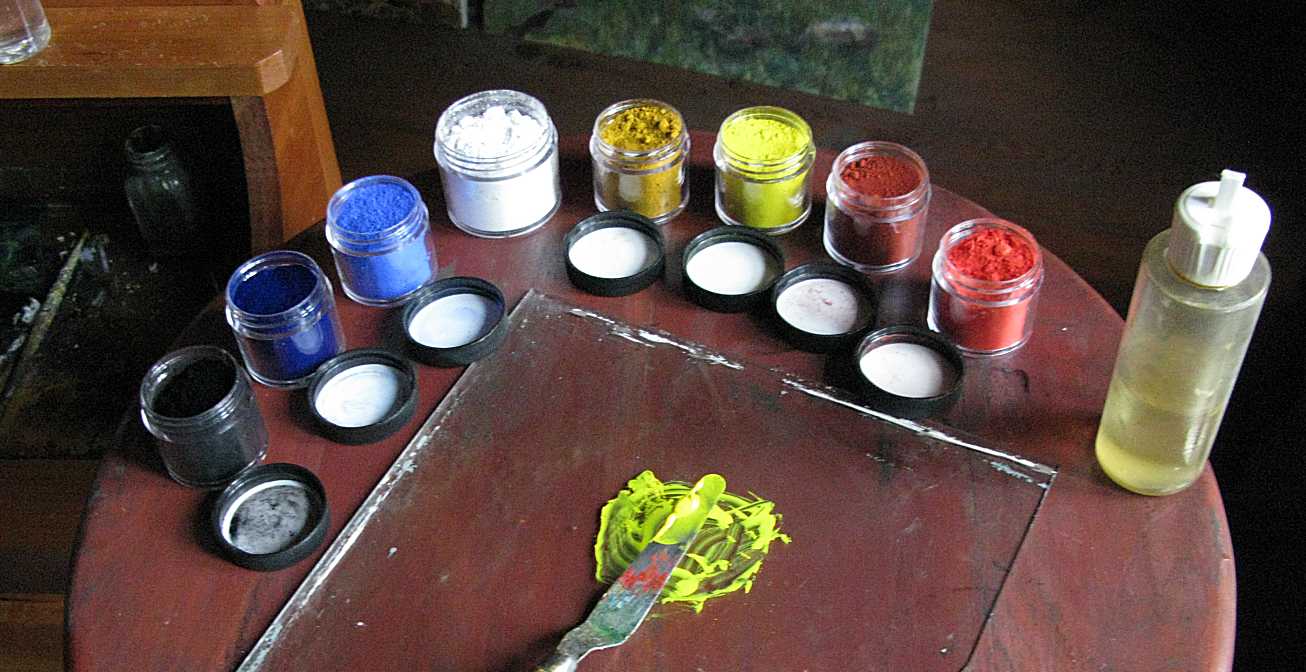
$48.50 per set. These 8-pigments/colors represent a perfect traditional palette for use with either landscape, portrait, or Marine paintings These artist's pigments are finely-ground (true pigments) and require no further grinding with the muller. It's simple to create your own oil paint! All you need is a preferred binder, a palette knife, and a sheet of scrap glass. At this time we only offer these pigments as a set; not sold individually. [Click on the product name for more info.] Ordering OnlineDrying Walnut Heat-Bodied Oil
($30.00) This product is no longer available. According to the many paint-analysis studies done by modern researchers, a heat-bodied oil can be detected often in the old master's works. Curiously, many of these works exhibit up-standing paint texture that, instead, visibly reflect the typical effects of resin-oil-varnish-use within the paint. Thus, this up-standing quality is not in accordance with the melting effect truly garnered with the use of common HB-Oils-- like standoil and my own historical version of Heat-Polymerized Walnut Oil. However, through a long and complex cooking procedure, linseed oil and walnut oil can be transformed into a fluid oil that does indeed produce upstanding texture to fresh oil paint. I no longer make this heat-bodied oil -- it is too complex to imagine any olden painter making and using it. [ Note: There is another heat-bodied oil --the so-called "burnt plate oil" --made by greatly heating an oil until it catches fire and assumes the consistency of liquid rubber. This much-thickened oil found use in lithography during Rembrandt's day. Some painters today believe this type of oil was used by that master to create his expressive pastose paint; and this thinking again being based on modern-day chemical analysis of the master's paint-chips. Having myself made many trials with this "fired oil", using it with handmade paints, I must respectfully disagree. The character this highly-heated oil evokes with lead white does not typically match Rembrandt's clever craftsmanship; rather, its use creates nothing more than an extreme slumpy-sluggish-ness. The reader should bear in mind that according to latest research, high temperature resin oil varnishes --like Amber Varnish or copal varnish, which are resins dissolved at extremely high temperatures into oils-- produce signatures of only heat-bodied oil. There is no signature of the resin. Apparently, the highly-cooked resins lose their basic "fingerprints" due to high-temperature heat-destruction. Again, this is according to the latest research and analysis. Thus, recent proclamations maintaining the old masters used only simple pigment-and-oil plus additions of heat-bodied oil are not truly supported. Again, the commonly-available oil varnishes of the day --which nearly every household had at ready for every-day use --give-off the very same finding of HB-oil. My own best-guess is the old masters utilized slight additions of highly-heated resin-in-oil varnishes to obtain the durability and application character of their wonderous paint -- and not simple heat-bodied oil. I encourage all to perform their own extensive trials in order to best decide the issue for themselves.Though I no longer offer it, my own Drying Walnut HB-Oil was utilized in creating the following :
Rembrandt: An Attempt to Copy his Self Portrait using Resin varnishes and heat-bodied oil. Click here
19th Century Siccatif de Courtrai
60 mil. bottle is $20.00 Made specifically for oil painting-use, this is the genuine article ; this is not the modern-day lead napthenate nor cobalt/manganese carboxylate driers available elsewhere. Unlike lead napthenate, our Siccatif de Courtrai will not dull oil paint ; and, instead, it leaves a proper fresh look to the paint. Normal use will not discolor whites/colors ; one partial drop can dry oil paint in as little as 8-12 hours. Favored by many 19th C. masters, including William Bouguereau. [Click on the blue heading for more info.] Ordering OnlineWalnut 'Black Oil' $18.50 per 60 mil bottle. Labeled as17th Century Light Drying Oilto differentiate it from common black oil. Can be used in an all-oil-and-no-solvent manner; or used with a solvent, if desired. This oil is made from unrefined walnut oil cooked with lead. Known historically as "drying oil" until Jacques Maroger miss-named it, our "b[[[[[lack oil" is anything but. It is a transparent golden-colored oil that will dry fast, increase lubricity; and, when combined with an equal amount of mastic spirit varnish, produces a fast and firm megilp jelly that has none of the faults of the linseed-based version. Ordering Online
Raw Walnut Oil 120 Mil. (4 -ounce) plastic bottle is $8.50. [No longr available] This pure nut oil contains no antioxidants. This lightly-colored oil provides excellent wettability and much faster drying than the commonly-available purified and refined walnut oil. Excellent for hand rubbing of pigments into paint. Ordering Online
Information for Modern Day Commercial 'Tube Paint' Enthusiasts
I have often been asked if the specialized varnishes we provide can be used with tube paints. Certainly, they can. In fact, as we have noticed over the years, most buyers of our varnishes and mediums are tube paint-users who have need for strengthening their " tube colors" so that a thinning with solvent (such as turps) can be effectively performed.
Painting by way of essential oils or spirits is a tried-and-true and very old manner of oil painting. Raw oil is used to rub up the basic paint, then a bit of varnish --usually a drop or two-- is added to stiffen or congeal the paint. This firm paint is then thinned for application using the chosen spirit, such as turpentine, paint thinner, or oil of spike. The paint is applied in thin translucent layers until the desired effect of realism is attained. The results are quite effective as, once given a slight dose of varnish, modern day tube paint will withstand much greater use of spirits, resulting in an almost egg-tempera-like manner of painting and building-up of layers ; promoting a quality of realism not nearly attainable without the varnish-addition. No other oil is incorporated with this manner.
The principle underlying the effective use of this technique derives from the exceptional binding-strength and congealing capabilities allowable through use of the varnish-addition. This is to say, basic oil and pigment paint (either "tube" or home-made), by itself, cannot be thinned much with a solvent without becoming poorly bound (underbound) or running, trickling, down the support. However, as early painters eventually found, by simply adding a drop or two of varnish, the binding-strength of the paint is much increased, resulting in a much firmer resistance against solvent-delivered overpainting, even when the underlying paint is wet ; additionally, the applied paint gains in translucency, delivering a final highly-keyed brightness not available to an all-fixed oil technique. BTW, of great benefit, the step known as "oiling out" ( which is so important to the all-fixed oil technique) is not required when using the spirit-use manner of oil painting. This combined spirit-with-oil technique was that of Rubens and other Northern painters (as well as many Italian painters at least dating back to some of Leonardo's works).
As for those tube paint-users today who prefer an all-fixed oil technique (no solvents such as turps, paint thinner, etc.), our unique Amber Gelling Oil works well with tube paints. So does the "Gentileschi's Amber Medium" made from the Venetian Amber Varnish and unrefined walnut oil. Ditto our Walnut Polymerized Oil, replacing standoil to good advantage.
However, the remarkable congealing (stiffening) abilities engendered by use of our amber, copal, and other varnishes were developed with hand-made oil paint in mind --like the stuff used by the olden painters. With handmade paint, these type high-in-resin oil varnishes provide character and interesting brushwork not found with modern day tube colors ; and this character is in addition to their lasting and optical qualities supplied to basic rubbed-up oil-and-pigment paint. By comparison, most tube paint today comes off the store-shelf already in a too-short condition. Adding our amber and copal varnishes will certainly toughen it--even optically brighten it-- but the consistency by that addition with some paint-brands may likely resemble window putty. All fine an proper if the painter wishes to then use spirit vehicles to subsequently apply the paint. But, excepting means of impasto, this stiff condition of the paint is not effective using all-oil, as the amounts of oil then added to make the paint easy of brushing would become excessive and troublesome. 'Oiling out' the ground before new paint-applications will help defray the problem. But, there is another way to incorporate these particular oil varnishes with tube paint in an all-oil manner.
First, realize, regarding an all-oil technique, modern day 'tube paint' behaves differently than the freshly rubbed-up oil paint made by the artist. Many believe what they are buying is a very pure form of basic pigment-and-oil in a tube, ready and waiting for their whim to create. Not so. Tube paint has a gelling substance added in to promote a short 'buttery' consistency and maintain shelf-life (meaning little-to-no separation and resultant slumping in the tube). Usually, this substance is an addition of extremely lightweight aluminum stearate ; and even 2% of AS will mean a substantiat amount has been incorporated into the paint. This gelled effect-- very much similar to adding wax to oil paint-- makes the paint seem ultra heavy in pigment-to-oil ratio and causes a 'short' and crisp brushstroke that bears essentially no appearance to what the old masters used in their day. Of course, some paints do perform better than others in this regard. But, overall, the store bought tube paint provides little resemblance to the freshly made oil paint ( or what was created 'yarns ago' on canvas or wood panel with the same).
Aluminum Stearate seems to date back to the 1930's but other tallow-type stabilizers very similar to it first came onto the scene in the late 1800's. In the 1940's, oil painters such as Frederick Taubes discovered that adding another 20th century product called "standoil" to tube paints overcame or balanced-out the aluminum stearate, easing or eliminating its short effect, allowing a "tall" or "long" (slightly more or complete enamel-like) effect -- quite similar to true basic all around handground paint. Taubes later created a copal varnish that relied heavily on standoil, and small additions of his copal varnish (called Copal Concentrate) would allow tube paint to behave much more like the old master-type paint. His product was marketed by the Permanent Pigments company and became quite popular.
I supply this information to those who wish to obtain the older-type copal and amber varnishes displayed herein, but who desire to incorporate them with modern day tube paint in an all-oil technique. Essentially, the secret is this: to create mediums that allow tube paint to resemble the older paint, a certain part of that medium should contain standoil--or other polymerized, or sun-thickened oil--in the mix ; and this is to overcome the too-short gel-effect of aluminum stearate. For simple example, the "Copal Concentrate" of Taube's make was said to be a 25% copal-to-75% standoil combination. I have since copied it nicely by taking two parts standoil and one part of our 19th C. Copal Varnish and heating the two together. Thus, a 50% copal resin-to-oil varnish (like our 19th Century Copal Varnishes) would require a good bit of standoil to garner the "copal concentrate" effect on tube paint. [In other words, you find a small medicine bottle and put therein one part of the copal varnish and then slowly add two parts stand oil or sun-thickened oil.] Such a mixed 'copal & standoil' varnish is VERY light in color and can then be added in slight amounts to tube paints, giving them a certain long-ish clever character (Taubes called this 'conditioning' the paint) that stays put and doesn't run down the canvas or support with gravity -- as would be the case with standoil alone. Various other and useful painting mediums for tube paints can also be made using this concocted copal-with-standoil varnish by adding in amounts of a preferred raw oil, turpentine, siccative drier, and/or other agents.
To satisfy some tube paint users who wish a true fossil copal varnish-made painting medium, please note that we do offer our DCV Copal Painting Medium (see above) which will produce excellent and lasting results.
What I write here notwithstanding, I understand there are some few paint-makers today who do make simple oil and pigment paint. Since there is no aluminum stearate or other gelling agent involved, these paints are perfectly suited to our straight varnishes for use in either a "spirit-technique" or an "all-oil" technique. Of course, for those painters who make their own paint, our varnishes--either alone or added to mediums --will provide all the tough and lasting optical qualities deemed desirable and necessary -- plus provide a shortening, chrispening character that is wanting to the basic handmade oil-and-pigment paint.
We offer artist's permanent pigments in a convenient 8-color set. $48.50 per set (Note: Pigments not sold individually). More info click here
For further information or to place an order, please use our onlne shopping page or call (301)689-3389 8:30 am-4 pm EST Tuesday through Saturday. Shipping costs are calculated according to number of items ordered. We ship only by USPS Domestic and International Shipping. There are some world countries (such as Nigeria) we cannot ship to. If in doubt, please call or email us (wmg@jamescgroves.com) before ordering.
Or send your own ordered items list with personal check/money order to:
Western Maryland Gallery
11425 Upper George's Creek Road SW
Frostburg, MD 21532